UNI_
 UNI project – Increasing Involvement of MSM in the Continuum of Care in Kazakhstan (2016 – 2021)
Funding: National Institute of Drug Abuse (NIDA)
Grant amount: 3’431’964 USD
The project goal: The study aimed to test the efficacy of a social network-based HIV intervention designed to increase the number of MSM who use drugs in Kazakhstan and engage them in the continuum of care.
Project Description: The study involved a phased clinical trial in Almaty, Shymkent and Astana involving MSM who use drugs. As part of the intervention, MSM served as experts and used social networking processes to increase their engagement in the HIV treatment continuum. The study included 629 people, of whom 254 reported having had an HIV test in the past 6 months.
The project results: The results of this clinical trial confirm that the PRIDE in HIV Care program is an effective behavioral intervention that can increase HIV testing rates among MSM in Kazakhstan, as well as encourage behavior change among people who have never received direct intervention.
Publications:
- Earlier Sexual Debut and Anti-Gay Victimization Among Men Who Have Sex With Men (MSM) in Kazakhstan (https://pubmed.ncbi.nlm.nih.gov/37272025/);
- Compounding vulnerabilities: victimization and discrimination is associated with COVID-19 disruptions to HIV-related care among gay, bisexual, and other men and transgender and nonbinary people who have sex with men in Kazakhstan (https://pubmed.ncbi.nlm.nih.gov/36628449/);
- HIV Stigma, Homophobia, Sexual and Gender Minority Community Connectedness and HIV Testing Among Gay, Bisexual, and Other Men and Transgender People Who Have Sex with Men in Kazakhstan (https://pubmed.ncbi.nlm.nih.gov/33743115/);
- Polydrug Use, Sexual Risk, and HIV Testing Among Cisgender Gay, Bisexual, and Other Men and Transgender and Nonbinary Individuals Who Have Sex With Men in Kazakhstan (https://pubmed.ncbi.nlm.nih.gov/36181500/).
- Reeder KG, Lee YG, Sung J, Vinogradov V, Zhakupova G, Mergenova G, Davis A, Paine EA, Primbetova S, Terlikbayeva A, Kali S, Hunt T, Wu E. Trans Health is Public Health: The Prevalence of HIV Among Trans and Gender Expansive People in Kazakhstan. Res Sq [Preprint]. 2024 Sep 24:rs.3.rs-5124958. doi: 10.21203/rs.3.rs-5124958/v1. PMID: 39399678; PMCID: PMC11469378.
- Laughney, C. I., Lee, Y. G., Mergenova, G., Vinogradov, V., Zhakupova, G., Paine, E. A., … & Wu, E. (2023). Earlier Sexual Debut as a Risk Factor for Substance Use Among Men Who Have Sex with Men (MSM) in Kazakhstan. Global Social Welfare, 1-8.
- Laughney CI, Lee YG, Mergenova G, Vinogradov V, Zhakupova G, Paine EA, Primbetova S, Terlikbayeva A, Wu E. Earlier Sexual Debut and Exchange Sex among Men Who Have Sex with Men (MSM) in Kazakhstan. J Sex Res. 2023 Jul;60(6):919-924. doi: 10.1080/00224499.2023.2167064. Epub 2023 Jan 19. PMID: 36657067; PMCID: PMC10354213.

 Project NOVA was a randomized control trial (RCT) funded by the National Institute on Drug Abuse (NIDA), focusing on women engaged in commercial sex work in Kazakhstan. The study assessed the effectiveness of a comprehensive microfinance intervention, including financial literacy and vocational training, against a control group receiving only the HIV risk reduction component. The intervention aimed to reduce new cases of HIV, STIs, and hepatitis C, as well as risks associated with sexual behavior and drug use among women in Almaty and Karaganda regions.
 Smart Couples project – Couple-based antiretroviral therapy (ART) adherence intervention for people who inject drugs in Kazakhstan (2019 – 2023)
 GHRCCA is currently launching a four-year research project called “Improving access of vulnerable groups to HIV prevention, diagnosis and treatment services in Kazakhstan” (BRIDGE project) in partnership with the Republican AIDS Center.
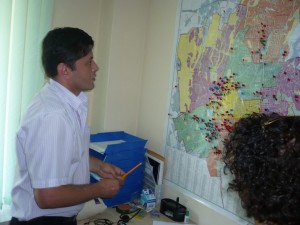 “Renaissance” Project is a five years research (2008 — 2013) implemented by the Global Health Research Center of Central Asia (GHRCCA) aimed at the preventive activity effectiveness evaluation to reduce the risks of HIV, hepatitis C and other sexually transmitted infections (STI). Research outcomes will allow addressing the wide range of aspects related to forming different HIV and STIs risks factors, and developing effective preventive measures against such diseases that in turn allow improving health and treatment services in Kazakhstan and other Central Asia countries. The main research result are the development of the new HIV and STI science-based preventive methods in working with heterosexual couples, adapted to the local conditions, obtaining the proof of the effectiveness, appropriateness, stability and need in applying the programs in public and treatment facilities activity in Kazakhstan, HIV, HCV and STI prevalence reduction in the country.
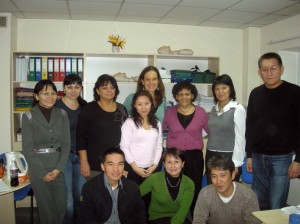 Having completed the project sessions I’ve got to know much useful information. Work with psychologists allowed me finding the way out of my problematic situation. So I think the project is very good and useful anyway. Regards. Sergey”.

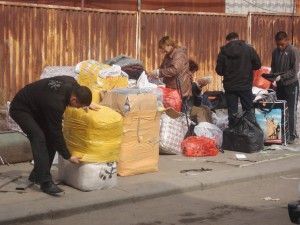 For the longitudinal study of the main quantitative phase, 1600 » Barakholka » market workers were recruited using RDS sampling method (respondent driven sampling). The sample consisted of 1280 migrants from Kazakhstan, Kyrgyzstan, Uzbekistan and Tajikistan, and 320 market workers, non-migrants, who resided Almaty and were the citizens of Kazakhstan. Participants undergo a baseline assessment at their first visit, and then at 3, 6, 9 and 12 months follow-ups, completing audio computer-assisted interview, reflecting data recognized by the participant on their behavioral risk, migration characteristics and socio-demographic questions. We will collect laboratory data to confirm of HIV/STI status at the first visit to the project office and after 12 months of the project completion.